 UN
UN United Nations Peacekeeping

Conflict update: Security Council extends peacekeeping mission in Abyei in face of stalled peace efforts
“The political process between the Sudan and South Sudan on Abyei and border issues remains stalled,” warned UN Assistant Secretary-General for Africa Martha Pobee last month. Situated along the boundary between Sudan and South Sudan, the territory of Abyei has been fiercely contested by the two countries since their separation in 2011. The territory continues to experience cycles of violence and displacement, with civilians bearing the brunt.
In November, the Security Council extended the mandate of the peacekeeping mission in Abyei, UNISFA, reaffirming its commitment to regional stability. However, despite significant progress in protecting civilians and alleviating intercommunal tensions, the mission is facing an increasingly complex landscape as it seeks to implement its mandate over the coming year.
UNISFA: a stabilizing presence despite stalled political process
Since 2011, UNISFA has been protecting civilians in Abyei, addressing intercommunal tensions, facilitating humanitarian assistance, and promoting law-and-order while supporting dialogue between Sudan and South Sudan to find a long-term, peaceful resolution to the dispute over Abyei.
UNISFA has stood ready to support key elements of the 2011 political agreement between the two countries, which envisioned interim administrative and security structures for Abyei until a final political resolution can be reached. This includes support the Abyei Police Service once it has been established, and to mechanisms like the Joint Political and Security Mechanism and the Abyei Joint Oversight Committee, through which Sudan and South Sudan were envisioned to jointly manage political, administrative, and security matters in the territory.
However, progress on these initiatives has been slow, particularly since the outbreak of war in Sudan in April 2023 and increasing political instability in South Sudan. Since 2023, neither government has participated in the Joint Political and Security Mechanism and the Abyei Joint Oversight Committee, and plans to operationalize the Abyei Police Service remain on hold.
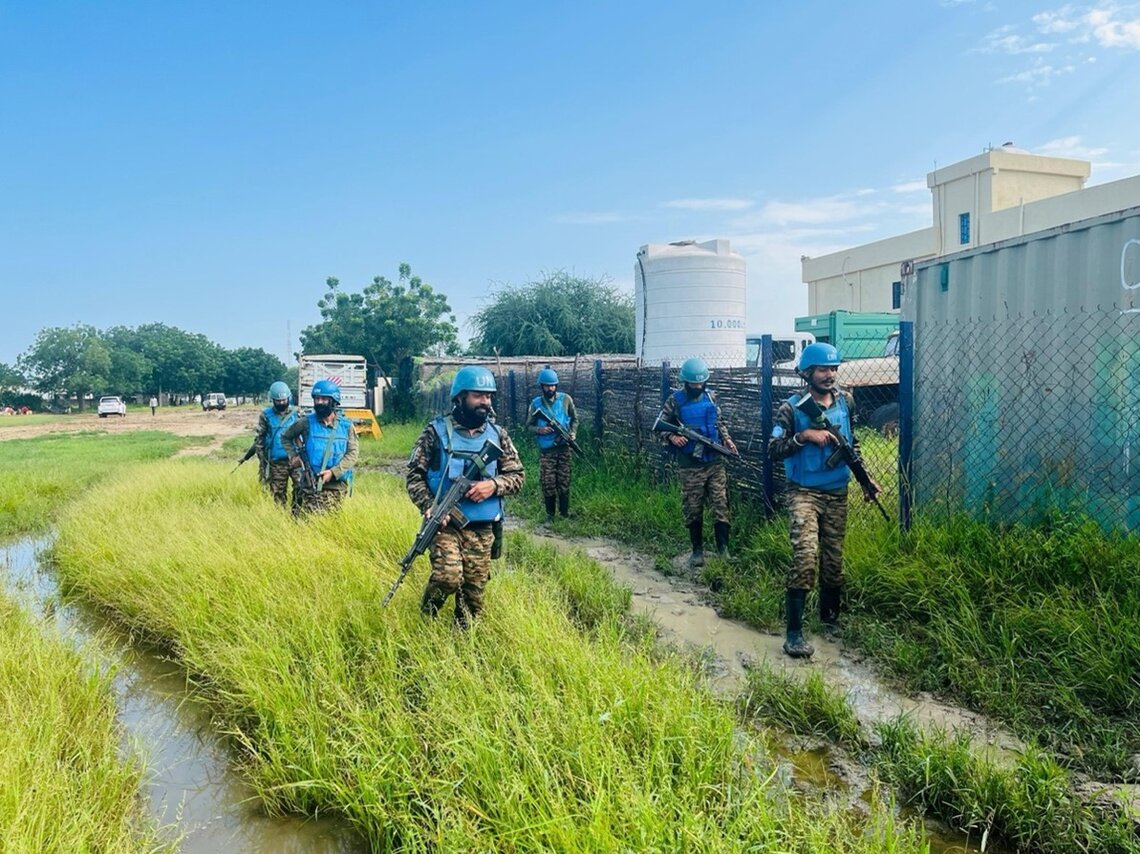
UNISFA continues to call for renewed engagement by both countries while supporting community initiatives that help maintain law and order until long-term solutions can be found. Critically, UNISFA is helping maintain Abyei as a demilitarized zone and protecting civilians from violence. It is conducting patrols to maintain peace and security and curb criminality and is establishing community-based law and order mechanisms, helping bring some stability to Abyei.
The mission’s work to promote reconciliation between communities has also significantly reduced intercommunal violence through initiatives like the Joint Community Peace Committee that brings together leaders of the Misseriya and Ngok Dinka communities, who have historically clashed over rights in the territory. The mission also facilitated an agreement between the Twic and Ngok communities, which ended a two-year long conflict between them. These gains have largely been maintained despite the worsening regional environment in recent years. However, without progress in the political process, long-term peace remains at risk.
Growing challenges
While the political process has stalled, security concerns are also increasing. In the north, the unauthorized presence of the Rapid Support Forces – a group involved in the war in Sudan – has led to rising criminality, illegal checkpoints, and insecurity. In the South, the presence of the South Sudanese forces violates Abyei’s demilitarized status, undermining stability.
At the same time, a budgetary crisis facing UN Peacekeeping has forced UNISFA to reduce its personnel, limiting its ability to sustain peace and stability in this fragile area.
What’s next?
As the political and security challenges in Sudan and South Sudan continue, Abyei finds itself in an increasingly precarious position. Heightened humanitarian needs and a lack of basic resources are compounded by rising security and political tensions.
“[UNISFA’s] presence and role are more essential than ever in the current context in Abyei,” said the Representative of Guyana during the Security Council vote on UNISFA. With the mission’s mandate now renewed, solidarity – as well as political and financial support – are required from the international community to support its implementation in the face of growing complexity, to ensure a peaceful resolution for Abyei.

Background
The resource-rich territory of Abyei has long seen disputes over its control. In 2005, the Government of Sudan and the Sudan People’s Liberation Movement/Army signed a comprehensive peace agreement designating Abyei as a special administrative area and calling for a referendum to determine its final status. However, amidst rising tensions in the region, the referendum was never held. In 2011, as South Sudan approached independence from Sudan, Abyei became a flashpoint for violence and mass displacement.
In response to the escalating insecurity, the Security Council established the United Nations Interim Security Force for Abyei (UNISFA) to help monitor the withdrawal of both countries’ forces from the territory and to support dialogue between Sudan and South Sudan to find a political resolution on the status of Abyei and restore peace and stability along their disputed border. The Security Council also endorsed the Agreement on Temporary Arrangements for the Administration and Security of Abyei, signed on 20 June 2011 in Addis Ababa, which sets out plans for how the two countries would jointly manage political, administrative, and security matters in the territory.
Today, Abyei remains contested, with meaningful dialogue on its future stalled. Recurrent clashes and population movements have created a growing need for humanitarian aid and a meaningful political process between Sudan and South Sudan to determine the final status of Abyei. The international community has emphasized that stability in Abyei is essential to ensuring peace between Sudan and South Sudan and preventing wider regional crisis.
In the interim, the mission is working to protect civilians in the volatile territory and maintain it as a demilitarized zone. It is also working to foster reconciliation between communities, address the root causes of conflict, support community-based law-and-order efforts, and facilitate humanitarian assistance to ease immediate threats and suffering.
UNISFA remains a vital stabilizing presence in Abyei, committed to upholding peace, security and human rights along one of the region’s most sensitive borders.
